 Periodic table
  Electron configuration
  Solubility table
  Metal operating range
  News
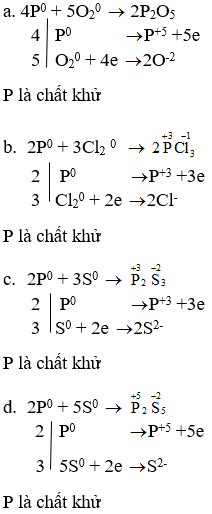
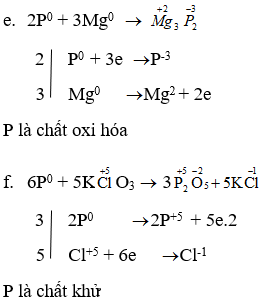
News Lập phương trình hoá học của các phản ứng sau đây và cho biết trong các phản ứng này, P có tính khử hay tính oxi hoá?
a. P + O2 → P2O5
b. P + Cl2 → PCl3
c. P + S → P2S3
d. P + S → P2S5
e. P + Mg → Mg3P2
f. P + KClO3 → P2O5 + KCl
Tìm kiếm câu hỏi hóa học
Hãy nhập vào nội dung câu hỏi để bắt đầu tìm kiếm
Lập phương trình hoá học của các phản ứng sau đây và cho biết trong các phản ứng này, P có tính khử hay tính oxi hoá?
a. P + O2 → P2O5
b. P + Cl2 → PCl3
c. P + S → P2S3
d. P + S → P2S5
e. P + Mg → Mg3P2
f. P + KClO3 → P2O5 + KCl
Nguồn: SGK Hóa 11
Total rating:
Rating: / 5 star
Este X có công thức phân tử C2H4O2 . Đun nóng 9,0 gam X trong dung dịch NaOH vừa đủ đến khi phản ứng xảy ra hoàn toàn thu được m gam muối. Giá trị của m là:
Thực hành: Tính chất của natri, magie, nhôm và hợp chất của chúng
Cho các chất : etyl axetat, etanol, axit acrylic, phenol, phenylamoni clorua, phenyl axetat. Trong các chất này, số chất tác dụng được với dung dịch NaOH là :
Vì sao phản ứng hóa học của buta – 1,3- đien và isoprene có nhiều điểm giống nhau?
Hydrogen is the first element in the periodic system table. Hydrogen is known to be the lightest of all, the most abundant in the Universe, the essential element for life
View moreHelium is the first rare gas element in the periodic system table. In the Universe, it ranks second in abundance after elemental hydrogen.
View moreLithium is the alkali metal element, located in the third cell in the periodic table system. Lithium is the lightest of all solid metals and can cut a knife.
View moreBeryllium is the lightest alkaline earth metal. Beryllium is found in precious stones such as emeralds and aquamarine. Beryllium and its compounds are both carcinogenic.
View moreCarbon is the non-metallic element in the sixth cell in the periodic system table. Carbon is one of the most important elements in all life, it is also known as the back.
View more