Search substance

Please enter substance to start the search

Note: You can search for multiple substances at the same time, each separated by a space, for example: Na Fe

Điểm khác nhau giữa chất Pyridinium ion và chất Axit stearic

So sánh các tính chất vật lý, hoá học giữa chất Pyridinium ion và chất Axit stearic


Điểm khác nhau giữa chất Pyridinium ion và chất Axit stearic

Tính chất Pyridinium ion Axit stearic
Tên tiếng Việt Pyridinium ion Axit stearic
Tên tiếng Anh Stearic acid; Octadecanoic acid; Hydrofol Acid-150; Emersol-6349; Emersol-153; Hydrofol Acid-1895; Century-1220; Stearophanic acid; Stearex Beads; Neo-Fat 18; Neo-Fat 18-59; Neo-Fat 18-55; Neo-Fat 18-54; Neo-Fat 18-53; Neo-Fat 18S; Kam-2000; Kam-3000; Kam-1000; Industrene R; Hystrene 9718NFFG; Hystrene S-97; Hystrene-80; Hystrene T-70; 18:0
Nguyên tử khối 80.1078 284.4772
Khối lượng riêng (kg/m3)
Nhiệt độ sôi (°C)
Màu sắc
Độ âm điện
Năng lượng ion hoá thứ nhất
Phương trình tham gia Phương trình HC5H5N tham gia Phương trình CH3(CH2)16COOH tham gia
Phương trình điều chế Phương trình điều chế HC5H5N Phương trình điều chế CH3(CH2)16COOH

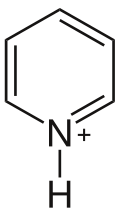
Substance HC5H5N (Pyridinium ion)

HC5H5N-Pyridinium+ion-989

Pyridinium ion có công thức [C5H5NH] +. Nó là axit liên hợp của pyridin. Nhiều cation liên quan được biết đến liên quan đến các pyridin được thay thế, như picolines, lutidines, collidine. Chúng được điều chế bằng cách xử lý pyridine với axit. Vì pyridin thường được sử dụng làm bazơ hữu cơ trong các phản ứng hóa học, nên muối pyridinium được tạo ra trong nhiều phản ứng axit-bazơ. Các muối của nó thường không hòa tan trong dung môi hữu cơ, vì vậy sự kết tủa là một dấu hiệu cho thấy sự tiến triển của phản ứng. Ion pyridinium cũng đóng một vai trò trong quá trình acyl hóa Friedel-Crafts. Khi pyridin có mặt, nó tạo thành một phức hợp với ion acylium electrophin, khiến nó phản ứng mạnh hơn. Các cation pyridinium có mùi thơm, được xác định thông qua quy tắc Hückel. Chúng đẳng điện tử với benzen.

Substance CH3(CH2)16COOH (Axit stearic)

CH3(CH2)16COOH-Axit+stearic-340

Axit stearic là chất rắn màu trắng, mùi nhẹ. Nổi trên mặt nước. Nó là các axit béo bão hòa với một chuỗi 18 carbon và có tên IUPAC axit octadecanoic. Axit stearic là chất rắn dạng sáp có công thức hóa học là CH3-(CH2)16-CO2H. Chất này có mặt trong nhiều dầu mỡ động vật và chất béo thực vật, nhưng phổ biến hơn so với chất béo thực vật (thường chứa hàm lượng acid stearic <5%) là mỡ động vật( chiếm khoảng 30%) Axit stearic là một axit béo mạch dài bão hòa có xương sống 18 cacbon. Axit stearic được tìm thấy trong các chất béo động thực vật khác nhau, và là thành phần chính của bơ ca cao và bơ hạt mỡ.

Total rating:

Rating: / 5 star


Interesting facts about chemistry you may not know

Interesting facts about hydrogen - the lightest element in the periodic table.

Hydrogen is the first element in the periodic system table. Hydrogen is known to be the lightest of all, the most abundant in the Universe, the essential element for life

View more

Interesting facts about helium

Helium is the first rare gas element in the periodic system table. In the Universe, it ranks second in abundance after elemental hydrogen.

View more

Interesting facts about lithium

Lithium is the alkali metal element, located in the third cell in the periodic table system. Lithium is the lightest of all solid metals and can cut a knife.

View more

Interesting Facts About Beryllium

Beryllium is the lightest alkaline earth metal. Beryllium is found in precious stones such as emeralds and aquamarine. Beryllium and its compounds are both carcinogenic.

View more

Interesting Facts About Carbon

Carbon is the non-metallic element in the sixth cell in the periodic system table. Carbon is one of the most important elements in all life, it is also known as the back.

View more