 Periodic table
 Electron configuration
 Solubility table
 Metal operating range
 News

Anyone who has worked near an advertising or marketing team knows the moment. A new campaign platform needs to go live, it will touch customer data, and suddenly someone asks whether the system has been authorized, which controls apply, and who signs off. Those questions sit at the heart of governance, risk and compliance work, and they are exactly what the ISC2 CGRC certification measures. If you are preparing for that exam, how you practice matters as much as how much you read. This article walks through a simple method built around timed mock exams and careful review of explanations.

Course cover for the ISC2 CGRC practice test set, showing a professional beside a certificate and an authorization workflow diagram
What the exam actually asks of you
Before building a study routine, it helps to know the target. According to the ISC2 published CGRC exam outline, the exam has 125 items, runs for 3 hours, and requires a score of 700 out of 1,000 to pass. The items are a mix of multiple choice and advanced item types. ISC2 lists the exam as available in English and delivered through Pearson testing centers.
The outline also splits the content into seven domains, each with a stated weight:
- Security and Privacy Governance, Risk Management, and Compliance Program: 16%
- Scope of the System: 10%
- Selection and Approval of Framework, Security, and Privacy Controls: 14%
- Implementation of Security and Privacy Controls: 17%
- Assessment/Audit of Security and Privacy Controls: 16%
- System Compliance: 14%
- Compliance Maintenance: 13%
ISC2 also lists two years of required work experience for the certification. That detail matters for planning, because the exam is written for people who have seen authorization packages, control baselines and assessment reports in practice, not only in a textbook. Always check the current outline on the ISC2 site, since the weights and details can be revised.
Why timed mock exams change how you study
Reading a framework document feels productive, but it mostly trains recognition. The real exam demands recall under pressure, and three hours is long enough that pacing and fatigue become real factors. A timed mock exam lets you rehearse all of that without any stakes.
A few practical reasons to run full-length, timed sessions rather than untimed question drills:
1. You learn your pace. With 125 items in 3 hours, you have roughly a minute and a half per item. Some items will take 30 seconds. Others will eat four minutes. Practicing under the clock teaches you when to flag an item and move on.
2. You find your fatigue point. Many candidates discover that accuracy drops in the final third of a long sitting. Knowing that in advance lets you plan breaks, hydration and a steady rhythm.
3. You see the whole blueprint. A full test touches every domain, so weak areas show up in proportion to how the real exam weights them.
4. You reduce surprise. The first time you sit a long exam should not be the real one.
The practice set I want to describe here is the ISC2 CGRC exam simulator from Be Ready Education on Udemy. It is made up of 5 timed practice tests with 125 questions each, 625 questions in total, and every question comes with an explanation. You can see the course page here: ISC2 CGRC practice tests. It is independent study material and is not affiliated with or endorsed by ISC2.
A simple three-pass method
The value of a mock exam is not the score. It is what you do afterward. Here is a routine that works well with a set of five full-length tests.
Pass one: a cold baseline
Take the first test under realistic conditions. Set a 3 hour timer, close your notes, and sit somewhere quiet. Do not look anything up. Flag items you are unsure about, but still commit to an answer.
When you finish, resist the urge to focus on the percentage. Instead, sort your misses into three buckets:
- Did not know the concept. You had no idea what the item was testing.
- Knew the concept, misread the item. You rushed, or missed a word like "first" or "best."
- Narrowed to two, picked wrong. You understood the area but not the nuance.
Each bucket calls for a different fix. The first needs study. The second needs slower reading. The third needs deeper comparison of similar ideas.
Pass two: review every explanation, including the ones you got right
This is the step most people skip. If you guessed correctly, you learned nothing. If you were right for the wrong reason, you are exposed. A good explanation does more than name the correct option. It tells you why the other options fail in that scenario.
For CGRC-style material, that distinction is critical. Many items describe a system, a risk and a stakeholder, then ask what should happen next in the authorization process. Several answers may be reasonable in general, but only one fits the stage of the lifecycle described. Reading why the plausible distractors are wrong teaches you to place each activity in the right phase, which is a skill you will use on the real exam and on the job.
Keep a short error log as you review. For each missed or shaky item, write one line:
- the domain it belongs to,
- the idea you were missing,
- a one sentence rule in your own words.
By the end of the first test you will have a page of rules. By the fifth, you will have a personal study guide that is far more useful than any generic summary, because it is built from your own gaps.
Pass three: targeted study, then a fresh test
Use the log to decide what to read. If most of your misses cluster in implementation and assessment, which together carry a large share of the outline weight, spend your time there. Go back to the source frameworks and the ISC2 outline, read the relevant sections, and then try the next test.
Space your tests out. Two or three days between full-length attempts gives you room to study and lets the material settle. Taking all five in a single weekend produces a lot of fatigue and not much learning.
Reading the scores honestly
A rising trend across tests is a good sign, but be careful about reading too much into any single number. Practice scores come from a question set that was not written by the exam authors, so they cannot predict your result on the real exam. What they can do is show you where you are weak, how consistent you are, and whether your pacing holds up.
A more useful measure than overall percentage is domain level performance. If you consistently score well in governance and compliance maintenance but struggle with system scope, you know where the next study session goes. Treat the numbers as a compass, not a forecast.
It is also worth being clear about the limits of any practice set. No bank of questions replaces the official ISC2 materials, and none replaces hands-on experience with real authorization packages. If you have never written a control implementation statement or reviewed an assessment report, spend time with real examples, or ask a colleague to walk you through theirs. Practice tests sharpen your recall and judgment. They do not substitute for the experience the certification is designed to recognize.
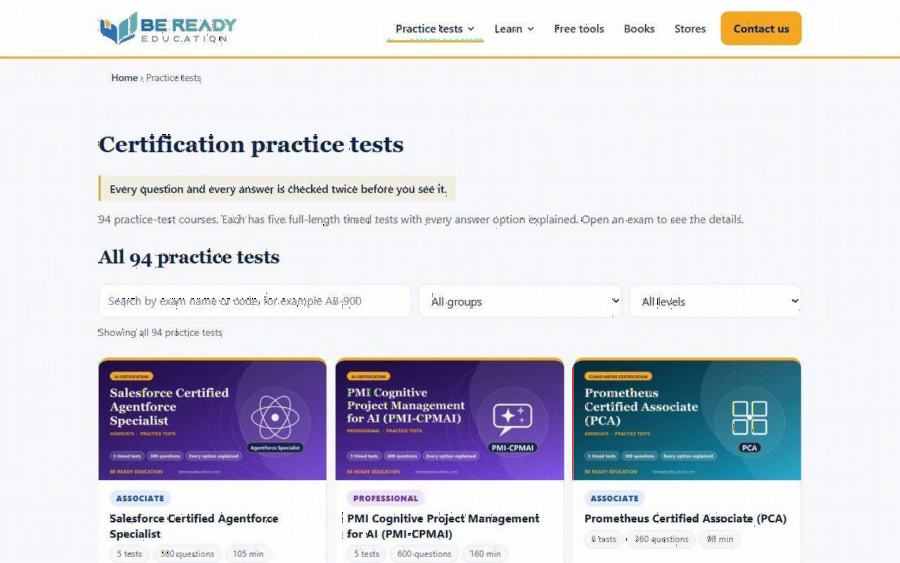
Be Ready Education practice test catalog page listing certification practice test courses with test counts and durations
Habits that make the review stick
Small habits compound over several weeks of preparation:
- Study in short blocks. Forty five minutes of focused review beats three hours of drifting. Save the three hour block for the mock exams themselves.
- Explain it out loud. After reading an explanation, say the reasoning in your own words. If you cannot, you have not learned it yet.
- Tie ideas to a real system. Pick a system you know, even a simple internal tool, and walk it through categorization, control selection, implementation, assessment, authorization and monitoring. Abstract steps stick better when they are attached to something concrete.
- Revisit flagged items a week later. Return to your error log before each new test. Repeated retrieval is what moves a rule from short term to long term memory.
- Protect the last two days. Skim your log, rest, and arrive at the test center alert. Cramming a new domain at the last minute rarely pays off.
Putting it together
A realistic plan for a working professional might run four to six weeks. Start with the ISC2 outline and your preferred primary reading. Take the first timed test as a baseline in week one, review every explanation, and build your error log. Use the following weeks for targeted study, with a new full-length test every few days to a week. Keep the final test for the last week, as a dress rehearsal under real timing.
If you want a ready-made set to follow this method, the course linked above gives you five full-length tests with explanations for each item. Be Ready Education also keeps a catalog of other exams, see its wider list of certification practice sets, which can be handy if you are planning a longer certification path.
Whichever materials you choose, the principle holds. Simulate the real conditions, review every explanation, record your gaps in your own words, and let the results guide your next study session. Do that consistently, and the exam becomes less of a mystery and more of a familiar routine. Good luck with your preparation.